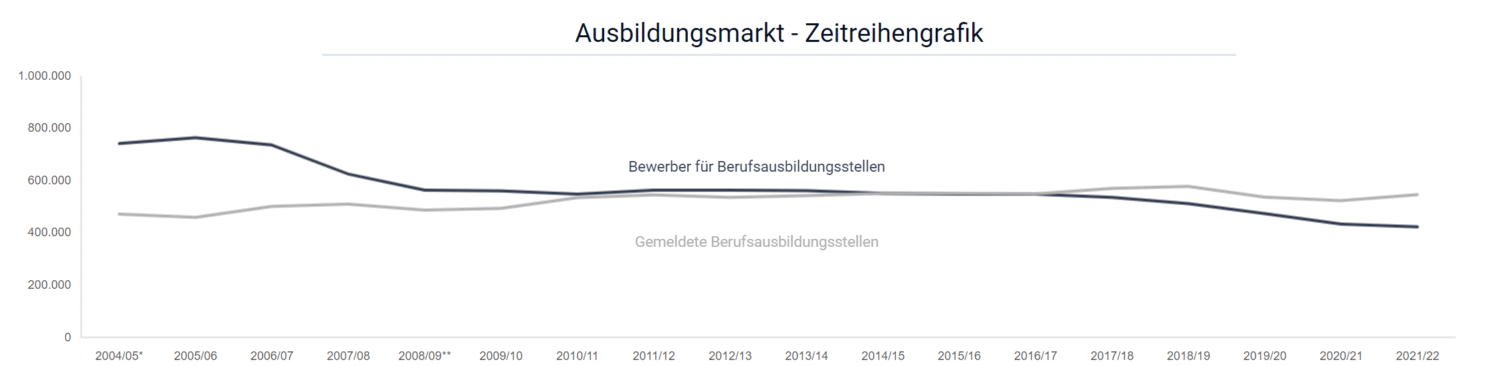
The German training market has been in crisis for several years. There are simply not enough applicants for the open training positions. This trend is becoming increasingly acute as the current low birth cohorts are entering the market. Another serious factor is the ongoing academization of Germany. In 2019, the number of students (2.9 million) was more than twice as high as the number of trainees (1.3 million).

Other reasons for the imbalance: Many of the training vacancies no longer match the interests of young people. In addition, apprenticeships are often offered in rather "unattractive" regions. Industry also often criticizes the fact that there are too few advisory services in schools.
As a result of these developments, there were only 422,400 registered applicants for every 545,960 registered vocational training places in 2021/2022. Whereas just a few years ago, applicants had to queue up at companies, the situation has now reversed. This fits in with the general situation of staff shortages in Germany and exacerbates the situation even further. Today's trainees are the potential skilled workers of the future.
How to reach a young target group
Some of the solutions envisaged for the labor market cannot be applied to the training situation. The lack of trainees, for example, cannot be compensated for by targeted immigration. A more effective approach would be an initiative in which the advantages and prospects of apprenticeships are explained earlier and more intensively in schools. It is also worth considering the extent to which the general conditions can be made more attractive. In addition to salary, topics such as meaningfulness, flexibility and self-determination also play an important role for young people. Is such content reflected in apprenticeships?
In the current situation, however, ideas are already needed to reach suitable candidates. In addition to traditional approaches such as career and training fairs, vocational training programs at schools, etc., it is also important to strive for contemporary measures. Channels such as social media, search or programmatic marketing are worth mentioning here.

Generation Z is particularly active on networks such as TikTok, Snapchat and Instagram. Even if these platforms are not usually used to find out about professional development, they are still channels that can be used to reach the right target group. Expectations here should remain within a realistic framework. With a well thought-out and appealing campaign, suitable candidates can certainly be found. But even if it does not lead to a direct result, the awareness created is of great importance. After all, this is how the attention is generated in the first place that there are open training positions at the company.
Programmatic campaigns can be used, for example, to precisely target locations where the users who are there are shown the advertising message via display ads. These can be schools, shopping centers, public places or other locations where young people prefer to spend time. Similar to social media, this is a passive approach because the target group is not actively looking for the information on offer.
The situation is different with search engine marketing. People who use search engines want to find information on a specific topic. It is therefore an active search that can be used to deliver the right message in a targeted manner. Another advantage of this approach is that the potential target group is very likely to include not only young people, but also their parents.
Children have parents
Parents often play a major role in their children's career choices and further education. It can therefore make sense to address this generation as well. However, other platforms such as Facebook are better suited to this. With a combination of Facebook and Instagram, it is possible to reach both Gen Z and the parent generation. It is advisable to vary the approach and presentation of the campaigns and adapt them to the respective target group.
Even if the situation on the training market currently appears drastic, there are still opportunities to fill vacant training places in a targeted manner. In addition to creating attractive framework conditions, it is also important to know where and how to reach the right target group in order to convince them of your offer.
Sources:
Image by rawpixel.com on Freepik
Image by pressfoto on Freepik