How they work and what they can do
At first glance, it may sound unusual to want to recruit employees via social networks. As a rule, people spend their free time there and are primarily interested in topics other than their professional career. Unlike business networks such as LinkedIn and XING, it therefore seems unlikely that people are actively looking for job vacancies on platforms such as Facebook or Instagram.

But despite these circumstances, very successful recruiting campaigns can also be realized here, especially with the use of so-called lead ads. This form function can be used to collect data from potential applicants quickly, easily and efficiently. Although this form of advertising is not new, it is becoming increasingly popular, particularly in recruitment marketing.
In this article, we look at the benefits of lead ads and back this up with figures from our daily work. We also explain what to look out for when implementing such campaigns. In addition to the positive aspects, we also look at the challenges and weaknesses of lead ads.
What are lead ads?
A lead ad is an ad format that combines a classic ad with a form that can be filled out quickly and easily by the user. This can be used, for example, to generate registrations for events, new newsletter subscribers or potential applicants.
The advertisement consists of a post image plus post text, as well as an image and text for the form. The form can be supplemented with individual questions, for example about the candidate's education or professional experience. Information on the use of the data and a link to the privacy policy should also be included. Finally, a concluding thank-you text with an external link can be included.
Who offers lead ad formats?
The first platforms that come to mind are certainly Meta: Facebook and Instagram are often used for lead generation. But these are by no means the only networks that offer lead ad formats. Implementation on the business networks LinkedIn and XING is fairly new. Depending on the industry, it makes sense to rely on these platforms. Perhaps somewhat more surprisingly, TikTok and Snapchat now also offer the opportunity to collect data from interested users via lead ads.
The providers therefore each have more or less specific core target groups. The choice of the right social media channel therefore plays a major role in reaching the right people.
The advantages of lead ads
As already mentioned, a particular strength of lead ads lies in their simplicity. It doesn't take long to fill out and send the form, and often the contact information that a user has provided on the respective platform is already pre-filled. They also offer great accessibility when making contact. Users can remain in the well-optimized mobile app throughout the entire process. There is no need to fill in extensive information fields or upload application documents. Compared to the application process via a website, this is much more user-friendly and results in fewer applications being abandoned.
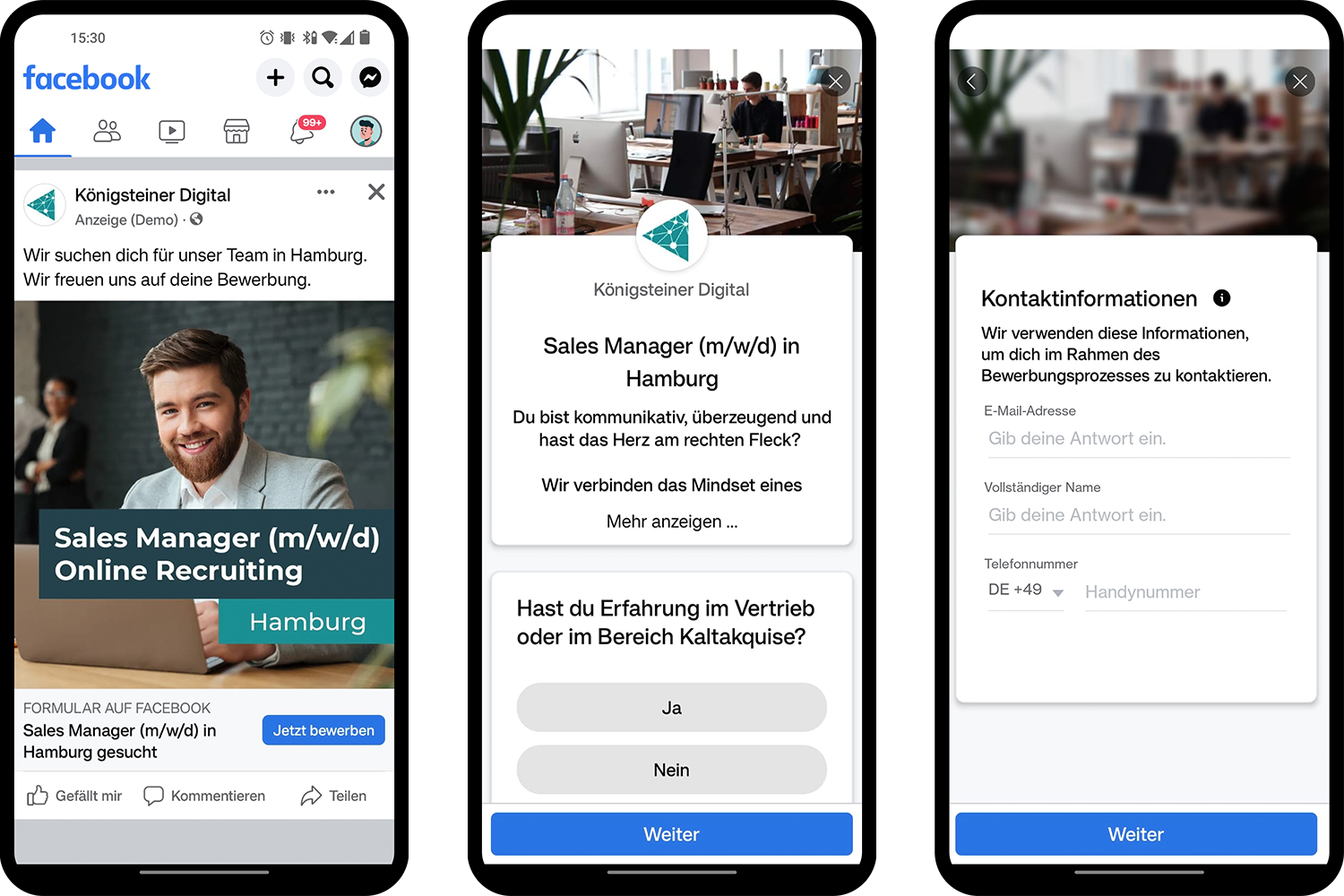
Setting up and maintaining the lead ad is also relatively simple. The only requirement is a business account with the respective platform. You can get started with a short text and a few images. The leads can then be managed in the Business Manager or downloaded for further processing.
Specific targeting is an excellent way of addressing different target groups. Depending on the industry, some platforms are more suitable than others. If you are looking for drivers in the logistics sector, you should use Facebook and Instagram instead of focusing on LinkedIn or Xing. TikTok or Snapchat are a good choice for trainees. This can lead to above-average conversion rates and therefore means the acquisition of a large number of useful leads.
Our daily work with lead ads shows how effective such campaigns can be. The ratio of clicks (on the form) to actual applications is often ten times higher compared to a conservative application form.
Challenges
As already mentioned, lead ad formats are not equally attractive for all sectors. They often work particularly well in the so-called blue collar sector, i.e. the commercial job market. Of course, this does not rule out using them for job applications for academic workers.
The information that recruiters receive from lead ads is limited. To get a complete picture of the applicant, further documents are missing. This is why the initial contact is often the first priority. Further information can then be obtained in the course of the process.
A current trend in recruiting can also be found in the application process via lead ads. We are talking about the ghosting of applicants. The non-binding structure of an application via social networks encourages the tendency to no longer respond to contact requests.
Lead ads are a modern, simple and efficient tool for reaching passive candidates via social networks and significantly increasing the number of applications received.